Month: April 2026

opalescence 20 instructions pdf

Category : Instructions

Opalescence 20 Instructions PDF: A Comprehensive Guide

Opalescence 20 offers a detailed guide for achieving a brighter smile, utilizing carbamide peroxide concentrations for effective whitening while minimizing discomfort and sensitivity․

What is Opalescence 20?

Opalescence 20 is a professional-level, take-home teeth whitening gel formulated by Ultradent Products, Inc․ It’s a popular choice among dental professionals and patients seeking noticeable whitening results․ This product utilizes a 20% carbamide peroxide concentration, a potent yet manageable level for achieving up to ten shades of whitening in approximately seven days, as clinically proven․

Unlike abrasive whitening methods, Opalescence 20 boasts a non-abrasive formula, prioritizing enamel health․ A key feature is its high water content – at least 20% – which helps prevent tooth dehydration during the whitening process․ The gel’s viscous consistency ensures it stays securely within the whitening tray, maximizing contact with the teeth and minimizing leakage․

Opalescence 20 is available in various formats, including Opalescence PF, designed for use with custom-fitted trays from your dentist, and Opalescence Go, featuring pre-filled, disposable trays for convenience․

Available Formats: Opalescence PF vs․ Opalescence Go

Opalescence PF (Professional Formula) requires custom-fitted trays created by your dentist, ensuring a precise and comfortable fit․ This format is ideal for patients seeking a tailored whitening experience and allows for flexibility in wearing time, typically 2-4 hours daily or overnight as directed by your dental professional․ It’s available in multiple carbamide peroxide concentrations – 10%, 15%, 20%, 35%, and 45% – allowing for personalized treatment plans․

Opalescence Go, conversely, offers unparalleled convenience with its pre-filled, disposable trays․ These trays are ready to use straight from the package, eliminating the need for a dental visit for tray fabrication․ Opalescence Go is available in a 20% carbamide peroxide concentration and is designed for a simple, hassle-free whitening experience․

Both formats share the same high-quality formula, including the high water content and non-abrasive properties, but cater to different preferences regarding customization and convenience․

Understanding Carbamide Peroxide Concentrations (10%, 15%, 20%, 35%, 45%)

Opalescence offers a range of carbamide peroxide concentrations to suit individual needs and sensitivity levels․ Lower concentrations, like 10% and 15%, are ideal for patients with sensitive teeth or those seeking a more gradual whitening process․ The 20% concentration strikes a balance between effectiveness and comfort, often used for moderate staining․

For more significant staining or faster results, higher concentrations of 35% and 45% are available, but these may increase the risk of sensitivity․ Your dentist will assess your teeth and recommend the most appropriate concentration based on your specific situation․

It’s crucial to follow your dentist’s instructions regarding wearing time and concentration to achieve optimal results while minimizing potential discomfort․ Higher percentages don’t necessarily mean faster results; proper usage is key․

Key Features of Opalescence 20 Whitening Gel

Opalescence 20 whitening gel distinguishes itself through several key features designed for optimal performance and patient comfort․ A notably high water content – at least 20% – prevents tooth dehydration during the whitening process, minimizing sensitivity and maintaining tooth health․ Its viscous formula ensures the gel remains securely within the trays, maximizing contact with the teeth and preventing leakage․

This gel is also formulated to be non-abrasive, protecting tooth enamel while effectively lifting stains․ Opalescence offers a variety of flavor options, enhancing the overall whitening experience․ The product is available in both PF (potassium nitrate) and Go (pre-filled trays) formats, providing flexibility for both custom and convenient applications․

High Water Content & Viscosity

Opalescence 20’s formulation prioritizes tooth health and whitening efficacy through its unique composition․ The gel boasts a remarkably high water content, exceeding 20%, which is crucial for preventing tooth dehydration during the whitening process․ This hydration minimizes sensitivity, a common concern with peroxide-based whitening systems, and helps maintain enamel integrity․

Complementing the high water content is the gel’s exceptional viscosity․ This “sticky” texture prevents the product from leaching out of the whitening trays, ensuring prolonged contact with the tooth surface․ This maximized contact time enhances the whitening effect, while the viscosity keeps the gel securely in place, leading to more predictable and consistent results․

Flavor Options

Opalescence 20 understands that comfort extends beyond minimizing sensitivity and includes a pleasant user experience․ To cater to individual preferences, Ultradent Products, the manufacturer, offers a variety of appealing flavor options․ These flavors are designed to make the whitening process more enjoyable, encouraging consistent use and adherence to the recommended treatment schedule․

Currently, Opalescence 20 is available in three distinct flavors: mint, melon, and bubblegum․ The mint flavor provides a classic, refreshing sensation, while the melon offers a subtly sweet and fruity alternative․ For those who prefer a more playful taste, the bubblegum flavor is an excellent choice․ This personalization allows patients to select a flavor that best suits their palate, enhancing their overall whitening journey․

Safety and Ingredients: Non-Abrasive Formula

Opalescence 20 prioritizes tooth enamel health with its carefully formulated, non-abrasive whitening gel․ Unlike some whitening products that rely on harsh abrasives, Opalescence utilizes carbamide peroxide to gently lift stains without causing damage to the tooth surface․ This is crucial for long-term dental health, as abrasive formulas can lead to increased sensitivity and enamel erosion over time․

The formula includes potassium nitrate, a key ingredient known for its desensitizing properties, helping to minimize discomfort during the whitening process․ Additionally, fluoride is incorporated to strengthen enamel and further reduce sensitivity․ Opalescence’s high water content – at least 20% – prevents dehydration of the tooth, maintaining tooth vitality․ This combination ensures a safe and effective whitening experience․

Application Instructions for Opalescence 20

Opalescence 20 application requires a dental check-up, sensitivity assessment, and precise tray fitting, ensuring optimal gel contact and effective whitening results․

Preparing for Whitening: Dental Check-up

Before beginning any teeth whitening treatment with Opalescence 20, a comprehensive dental check-up is absolutely essential․ This initial examination allows your dentist to assess your overall oral health, identifying any existing conditions like cavities, gum disease, or exposed roots that could potentially be aggravated by the whitening process․

Addressing these issues prior to whitening is crucial for both comfort and optimal results․ Your dentist will evaluate the health of your enamel and determine if you are a suitable candidate for Opalescence 20․ They can also discuss your expectations and create a personalized treatment plan tailored to your specific needs․ This consultation ensures a safe and effective whitening experience, minimizing potential sensitivity and maximizing the brightness of your smile․ Don’t skip this vital step!

Sensitivity Assessment

Assessing tooth sensitivity before starting with Opalescence 20 is a critical step towards a comfortable whitening journey․ Some individuals naturally have more sensitive teeth than others, and whitening can temporarily exacerbate this․ Your dentist can perform a simple sensitivity test during your pre-whitening check-up to gauge your potential reaction․

Opalescence PF formulas, particularly those used with custom trays, contain potassium nitrate, an ingredient specifically designed to minimize sensitivity․ However, preemptive measures are still wise․ If you have a history of sensitivity, discuss desensitizing toothpastes with your dentist and begin using one a week or two before starting treatment․ Be prepared for some mild sensitivity during the process, but it should be manageable․ Consistent communication with your dentist is key to addressing any discomfort․

Using Opalescence PF 20 with Custom Trays

Opalescence PF 20, designed for use with custom-fitted trays, delivers professional whitening results at home․ Your dentist will create these trays based on impressions of your teeth, ensuring a snug and comfortable fit․ This precise fit minimizes gel leakage and maximizes contact with tooth surfaces, enhancing whitening efficacy․

Before application, ensure your teeth are clean and dry․ Using the syringe provided, carefully apply a small amount of Opalescence 20 gel into each tray, following the guidelines provided by your dentist․ Avoid overfilling, as excess gel can cause irritation․ Gently seat the trays onto your teeth, ensuring complete coverage․ The viscous nature of the gel helps it stay in place, preventing migration․

Tray Fitting and Gel Application

Proper tray fitting is crucial for optimal whitening․ Your dentist-provided custom trays should fit snugly against your teeth without causing discomfort․ If you experience any significant pressure or movement, consult your dentist for adjustments․ Before each application, thoroughly clean and dry the trays to prevent dilution of the gel;

Gel application requires precision․ Using the supplied syringe, dispense a small ribbon of Opalescence 20 gel into each tray, ensuring it covers the facial surfaces of your teeth․ Avoid placing gel on your gums, as this can cause irritation․ The gel’s viscosity helps maintain its position within the tray․ Gently seat the trays onto your teeth, ensuring even coverage and minimal gel spillage․

Wearing Time: 2-4 Hours Daily

Consistent use is key to achieving optimal results with Opalescence 20․ Typically, trays are worn for 2 to 4 hours daily, as directed by your dentist․ Starting with shorter durations and gradually increasing can help minimize potential sensitivity․ Avoid prolonged wear beyond the recommended time, as it doesn’t necessarily enhance whitening and may increase discomfort․

Daily routine integration is important․ Many users prefer wearing the trays overnight or during a dedicated period each day․ Maintaining a consistent schedule ensures the carbamide peroxide effectively penetrates the enamel․ Remember to remove the trays after the prescribed time and rinse your mouth thoroughly with water․ Clinical studies demonstrate up to 10 shades of whitening within 7 days with consistent application․

Opalescence Go Instructions (Pre-filled Trays)

Opalescence Go offers a convenient, pre-filled tray system for effortless whitening․ These disposable trays are already loaded with 20% carbamide peroxide, eliminating the need for manual gel application․ Simply peel open the package and gently place the tray over your teeth, ensuring a snug and comfortable fit․

Proper placement is crucial for even whitening․ Bite down lightly to secure the tray and allow the gel to contact all visible tooth surfaces․ Avoid disrupting the tray during wear․ Opalescence Go trays are designed for single use; discard after each application․ Follow your dentist’s recommended wearing time, typically ranging from 30 minutes to several hours, depending on your sensitivity and desired results․

Tray Placement and Duration

Proper tray placement is essential for optimal Opalescence 20 results․ After applying the gel, carefully position the custom tray over your teeth․ Gently press the tray firmly against your teeth to ensure complete contact, preventing gel leakage․ A mirror can aid in accurate placement․

Wearing duration varies based on peroxide concentration and individual sensitivity․ Typically, with 20% carbamide peroxide, trays are worn for 2-4 hours daily, as clinically proven to whiten teeth up to ten shades in seven days․ Start with shorter durations if you experience sensitivity․ Avoid prolonged exposure beyond the recommended time․ Remove the trays after the designated period and rinse your mouth thoroughly with water․ Consistent use, as directed by your dentist, is key to achieving desired whitening outcomes․

Managing Sensitivity During Whitening

Sensitivity is a common side effect; Opalescence PF includes potassium nitrate to minimize discomfort, while breaks and fluoride treatments can also help․

Potential Side Effects and Troubleshooting

Opalescence 20, while effective, can cause temporary tooth sensitivity, a common side effect during whitening․ This typically subsides after treatment completion․ Gum irritation is also possible, usually mild and resolving quickly․ Should sensitivity become bothersome, reduce wearing time or discontinue use for a day or two, then resume with shorter intervals․

Troubleshooting: If experiencing prolonged sensitivity, utilize a desensitizing toothpaste containing potassium nitrate for several weeks before, during, and after whitening․ Avoid extremely hot or cold foods and beverages․ For gum irritation, ensure trays fit properly to prevent gel contact with soft tissues․ If irritation persists, consult your dentist․ Remember, Opalescence is a non-abrasive formula, minimizing enamel damage, but proper usage is crucial for optimal results and comfort;

Important Note: Discontinue use and consult your dentist if you experience any unusual or severe reactions․

Expected Results: Whitening Timeline (Up to 10 Shades in 7 Days)

Opalescence 20 is clinically proven to deliver noticeable whitening results, with many users achieving up to 10 shades lighter in just 7 days․ However, individual results vary based on initial tooth shade, concentration used, and consistent adherence to the recommended wearing time of 2-4 hours daily․ Initial improvements may be visible within a few days, with more dramatic changes occurring throughout the week․

Timeline: Expect subtle lightening within the first 2-3 days, progressing to more significant whitening by day 5․ Full results are typically apparent after 7 days․ Maintaining results requires periodic touch-up treatments, as directed by your dentist․ Remember, Opalescence’s high water content helps prevent dehydration, contributing to a natural-looking, lasting whiteness․ Consistent use is key to maximizing the benefits․

Storage and Handling of Opalescence 20

Proper storage is crucial to maintain the efficacy of Opalescence 20 whitening gel․ Store the unopened syringes at controlled room temperature, ideally between 18°C to 25°C (64°F to 77°F)․ Avoid exposure to direct sunlight, heat, or freezing temperatures, as these can degrade the carbamide peroxide concentration․ Once opened, use the syringe promptly and discard any unused gel after the recommended timeframe, typically within a few weeks․

Handling: Always use a clean, dry syringe applicator to dispense the gel into your custom trays․ Avoid contaminating the gel with saliva or other substances․ Ensure the syringe cap is securely closed after each use to prevent drying and maintain product integrity․ Keep out of reach of children and pets․ Follow all disposal guidelines for dental materials․

Where to Purchase: GoSupps․com, Amazon, Walmart

Opalescence 20 whitening products are readily available through several convenient retail channels, ensuring easy access for those seeking a brighter smile․ GoSupps․com offers a direct source, providing official brand products with express international delivery, and often features competitive pricing on the 8-pack DIY tray kits․

Amazon․com also carries Opalescence, including refill syringes and complete kits, offering the convenience of online shopping and potentially faster delivery depending on your location and Prime membership․ Additionally, Walmart․com provides another accessible option, stocking Opalescence 20 gel syringes in various flavors like melon, offering a familiar and trusted retail experience․ Always verify the seller’s authenticity to ensure you’re receiving a genuine product․


book of ecclesiastes pdf

Category : PDF

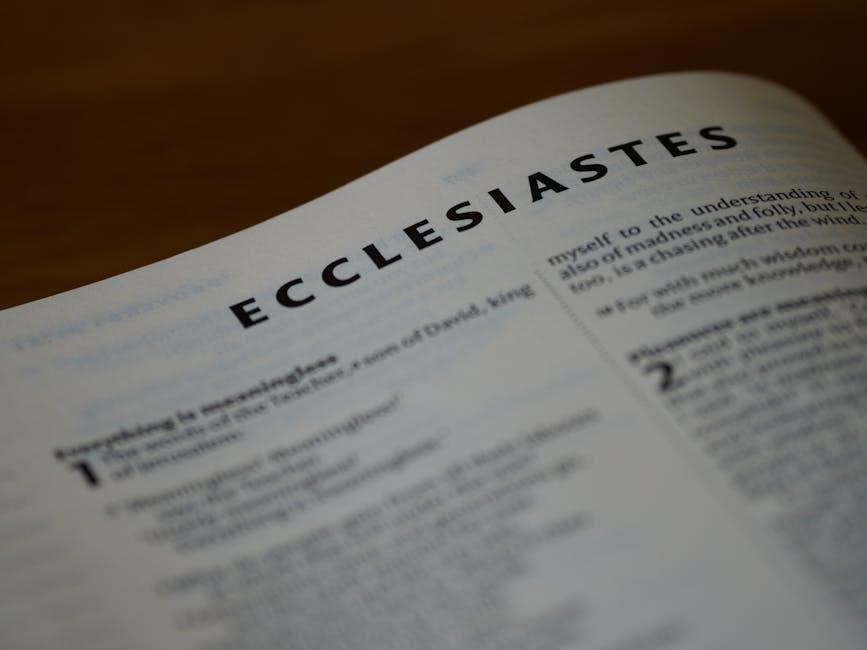
Ecclesiastes PDF: A Comprehensive Guide

Ecclesiastes‚ a profound biblical text‚ is readily available in PDF format for convenient study. Numerous online resources offer free downloads‚
including versions like Charles Siegel’s work and the King James Version from Project Gutenberg.

These PDFs facilitate in-depth exploration of its wisdom literature‚ offering access to timeless insights on life‚ faith‚ and eternity.

Understanding the Book of Ecclesiastes

Ecclesiastes‚ traditionally attributed to King Solomon‚ delves into the complexities of life‚ questioning its inherent meaning and purpose. Often categorized as wisdom literature within the Hebrew Bible‚ the book doesn’t offer simple answers but rather a realistic exploration of human existence. Its central theme revolves around the perceived “vanity” – or futility – of earthly pursuits.

Accessing Ecclesiastes in PDF format allows for focused study‚ enabling readers to dissect its poetic verses and philosophical arguments. The text‚ as presented in versions like those found on Project Gutenberg‚ encourages contemplation on topics like mortality‚ pleasure‚ and the pursuit of wisdom. Understanding the historical context‚ including the rabbinical debates surrounding its inclusion in the biblical canon‚ enriches the reading experience.

Charles Siegel’s “The Original Book of Ecclesiastes” PDF offers a specific interpretation‚ while the King James Version provides a classic rendering. Studying Ecclesiastes requires acknowledging its challenging nature; it’s a book that prompts introspection and a reevaluation of life’s priorities‚ ultimately pointing towards God’s plan and eternal hope.

Availability of Ecclesiastes in PDF Format

Ecclesiastes is remarkably accessible in PDF format‚ catering to modern Bible study practices. Numerous online platforms host downloadable versions‚ ranging from traditional translations like the King James Version to scholarly interpretations such as Charles Siegel’s “The Original Book of Ecclesiastes”. Project Gutenberg stands out as a reliable source‚ offering a free PDF of the KJV edition‚ promoting widespread access to this ancient text.

The convenience of PDFs allows for offline reading on various devices – computers‚ tablets‚ and smartphones – facilitating study anytime‚ anywhere. These digital copies often include features like searchable text and adjustable font sizes‚ enhancing the reading experience. Furthermore‚ the format lends itself well to annotation and highlighting‚ enabling deeper engagement with the scripture.

The proliferation of Ecclesiastes PDFs reflects a growing demand for accessible biblical resources. Whether seeking a classic translation or a specific commentary‚ readers can readily find a suitable digital version to explore the book’s profound wisdom.

Sources for Free Ecclesiastes PDF Downloads

Several reputable online sources offer free Ecclesiastes PDF downloads. Project Gutenberg is a primary resource‚ providing the King James Version as part of its extensive digital library. This allows access to a classic translation without cost. Additionally‚ various websites dedicated to biblical studies and religious texts frequently host PDF versions of Ecclesiastes in multiple translations.

Searching online using keywords like “Ecclesiastes PDF free download” yields numerous results‚ but caution is advised. Prioritize websites with established reputations and clear copyright information. PDF Drive and similar document-sharing platforms may also contain copies‚ though verifying the source’s legitimacy is crucial.

Charles Siegel’s “The Original Book of Ecclesiastes” is often available for free download directly from related websites or archives. Remember to respect copyright laws and utilize these resources responsibly for personal study and enrichment. Always scan downloaded files for malware before opening them.

Charles Siegel’s “The Original Book of Ecclesiastes” PDF

Charles Siegel’s “The Original Book of Ecclesiastes‚” published by Omo Press in 2014‚ presents a unique perspective on this ancient text. The PDF version of this work is often sought after by scholars and readers interested in a less conventional interpretation. Siegel’s approach aims to restore what he believes is the original meaning‚ often challenging traditional understandings.

This version gained attention for its attempt to address difficulties the rabbis faced when canonizing Ecclesiastes nearly two millennia ago. The PDF format allows for easy searching and annotation‚ facilitating detailed study of Siegel’s arguments and textual choices. It’s available through various online platforms‚ though verifying the source’s reliability is recommended.

Readers should be aware that Siegel’s work is not a standard translation but rather a reconstruction based on his research. It offers a thought-provoking alternative for those seeking a deeper‚ potentially controversial‚ engagement with the book of Ecclesiastes.

Project Gutenberg’s Ecclesiastes (King James Version) PDF

Project Gutenberg offers a readily accessible PDF version of Ecclesiastes‚ specifically the esteemed King James Version. As part of their extensive digital library‚ this edition provides a free and legally compliant way to study this significant work of Hebrew wisdom literature. The text is presented as “Book 21” within the Bible collection on the platform.

Downloading the PDF is straightforward‚ making it an excellent resource for students‚ researchers‚ and anyone interested in exploring the classic prose of the KJV translation. Project Gutenberg’s commitment to providing free ebooks ensures widespread access to this important religious text. The digital format allows for convenient searching‚ copying‚ and offline reading.

This version maintains the historical linguistic style of the 1611 translation‚ offering a glimpse into the language and theological interpretations prevalent during that era. It’s a valuable resource for comparative textual analysis and historical biblical studies.

Ecclesiastes as Part of the Hebrew Bible’s Wisdom Literature

Ecclesiastes firmly resides within the Hebrew Bible’s collection of Wisdom Literature‚ alongside Proverbs‚ Job‚ Psalms‚ and Song of Solomon. These books share a common focus on practical living‚ moral instruction‚ and the search for meaning in life‚ rather than solely focusing on law or historical narratives.

Unlike some biblical texts emphasizing divine commandments‚ Ecclesiastes delves into philosophical reflections on the nature of existence‚ the inevitability of death‚ and the perceived futility of human endeavors. Its unique perspective often prompts theological debate and encourages readers to grapple with complex questions about purpose and value.

Studying Ecclesiastes within this literary context illuminates its distinctive voice and thematic concerns. PDF versions of the text allow for focused analysis of its poetic structure‚ rhetorical devices‚ and its contribution to the broader wisdom tradition of ancient Israel. Accessing these PDFs enhances understanding of its place within the canon.

Key Themes in Ecclesiastes

Ecclesiastes grapples with several central themes‚ most notably the fleeting nature of life and the perceived meaninglessness of worldly pursuits. The recurring motif of “vanity” (hevel in Hebrew) underscores the transient and ultimately unsatisfying character of human endeavors. PDF versions of the text allow for detailed examination of this concept’s nuances.

Other prominent themes include the inevitability of death‚ the limitations of human wisdom‚ and the importance of enjoying simple pleasures within the constraints of mortality. The book also explores the role of fate and chance‚ questioning whether humans truly have control over their destinies.

Accessing Ecclesiastes in PDF format facilitates a focused study of these themes‚ enabling readers to trace their development throughout the book. Analyzing the text through a PDF allows for highlighting‚ annotation‚ and cross-referencing‚ deepening comprehension of its complex philosophical arguments.

The Meaning of “Vanity” (Hebrew: Hevel)

The Hebrew word Hevel‚ often translated as “vanity‚” carries a weight of meaning beyond simple emptiness. It signifies vapor‚ breath‚ or mist – something insubstantial and fleeting. In Ecclesiastes‚ it denotes the futility of striving after worldly possessions and achievements‚ as they ultimately prove transient and unsatisfying.

Studying Ecclesiastes in PDF format allows for careful examination of how Hevel is repeatedly employed‚ emphasizing the ephemeral nature of life. The author isn’t necessarily condemning all activity‚ but rather highlighting its limited significance in the grand scheme of existence.

A PDF version enables focused analysis of the context surrounding each instance of Hevel‚ revealing its nuanced application. It’s a reminder that human endeavors‚ while potentially enjoyable‚ lack ultimate‚ lasting value without a connection to something transcendent. The digital format aids in tracing this central concept throughout the book.

Ecclesiastes and the Concept of Eternity

While Ecclesiastes frequently emphasizes the fleeting nature of life “under the sun‚” the book doesn’t entirely dismiss the concept of eternity. Rather‚ it frames earthly existence in contrast to a timeless reality. A PDF version of the text facilitates a comparative study‚ allowing readers to discern subtle hints of a lasting purpose beyond the immediate.

The author acknowledges God’s role in judgment‚ implying accountability beyond the grave. Accessing Ecclesiastes as a PDF allows for easy cross-referencing with other biblical texts that explicitly address eternal life and divine justice.

The book’s exploration of wisdom‚ righteousness‚ and fearing God suggests values that transcend temporal concerns. Through careful reading – aided by the searchability of a PDF – one can perceive a longing for something permanent amidst the perceived meaninglessness. It subtly points towards a hope that surpasses earthly limitations.

Ecclesiastes’ Perspective on Life and Death

Ecclesiastes presents a strikingly realistic‚ and often somber‚ view of life and death. The book‚ readily available as a PDF‚ doesn’t shy away from acknowledging the inevitability of mortality and the apparent futility of human endeavors. It observes that “all is vanity‚” meaning life is transient and ultimately meaningless without a higher purpose.

A PDF format allows for focused study of verses detailing the shared fate of humans and animals – both returning to the dust. This perspective challenges conventional notions of lasting achievement and encourages a reevaluation of priorities.

However‚ the text also subtly suggests a need to enjoy the simple pleasures God provides during life‚ recognizing the limitations of our earthly existence. Studying Ecclesiastes in PDF form enables detailed analysis of these contrasting viewpoints‚ revealing a nuanced understanding of life’s complexities and the acceptance of death as a natural part of the cycle.

The Role of God in Ecclesiastes

While Ecclesiastes‚ easily accessible as a PDF‚ often emphasizes the seeming absence of inherent meaning in life‚ it doesn’t entirely exclude God. The author‚ traditionally linked to Solomon‚ acknowledges God as the ultimate judge and source of accountability. The book subtly implies that a fear of God—respecting His authority and moral law—is crucial‚ even amidst life’s frustrations.

A PDF version allows for careful examination of passages suggesting God’s sovereignty‚ even if His purposes aren’t always readily apparent to humans. The text doesn’t offer explicit theological explanations‚ but rather presents a realistic portrayal of a world where righteousness doesn’t always prevail.

Studying the book in PDF format reveals that the author encourages finding contentment within the boundaries God has set‚ accepting life’s limitations as part of a divine plan. Ultimately‚ Ecclesiastes points towards a need for faith and trust in a God who transcends human understanding.

Ecclesiastes and the Old Testament Context

Understanding Ecclesiastes’ place within the Old Testament is vital‚ and a PDF version facilitates focused study. Categorized as wisdom literature alongside Proverbs and Song of Solomon‚ it diverges in tone‚ offering a more skeptical and philosophical exploration of life’s meaning. Accessing the text as a PDF allows for easy comparison with these other books.

Within the broader Old Testament narrative‚ Ecclesiastes challenges conventional notions of reward and retribution. Unlike books emphasizing God’s direct intervention and blessing of the righteous‚ it portrays a world where fate seems arbitrary. A PDF allows for side-by-side analysis with books like Psalms‚ which frequently express trust in God’s providence.

Examining a PDF of Ecclesiastes reveals its unique contribution to the Old Testament canon – a realistic‚ sometimes pessimistic‚ reflection on the human condition‚ prompting readers to seek meaning beyond earthly pursuits and consider God’s ultimate judgment.

Ecclesiastes and Solomon’s Authorship

Traditionally‚ the book of Ecclesiastes is attributed to King Solomon‚ a figure renowned for his wisdom. However‚ modern scholarship debates this authorship‚ and a PDF version of the text allows for close textual analysis to explore this question. The opening verse identifies the author as “the son of David‚ king in Jerusalem‚” seemingly supporting Solomonic authorship.

Yet‚ linguistic and stylistic differences between Ecclesiastes and other Solomonic writings raise doubts. A PDF facilitates detailed comparison of vocabulary and literary style. Some scholars suggest a later author adopted the persona of Solomon to lend authority to their reflections. Examining a PDF allows for independent assessment of these arguments.

Regardless of the actual author‚ the Solomonic attribution significantly shapes the book’s interpretation. A readily available PDF enables readers to engage with this historical debate and consider how the perceived author influences the message of Ecclesiastes‚ its exploration of life’s meaning‚ and its perspective on worldly pursuits.

Interpretations and Theological Debates Surrounding Ecclesiastes

Ecclesiastes sparks considerable theological debate‚ largely due to its seemingly pessimistic outlook. A PDF version of the text allows for focused study of verses often interpreted as questioning life’s purpose. Some view the book as a cynical rejection of traditional religious values‚ while others see it as a realistic assessment of worldly limitations‚ ultimately pointing towards God.

The concept of “vanity” (hevel) is central to these debates. A PDF enables detailed examination of its various translations and contextual meanings. Is it utter futility‚ or simply the transient nature of earthly things? Theological interpretations diverge significantly. Accessing a PDF facilitates comparative analysis of different commentaries.

Furthermore‚ the book’s concluding exhortation to “fear God and keep his commandments” (12:13) presents an interpretive challenge. Does this reconcile the preceding skepticism‚ or is it a separate‚ appended moral lesson? Studying a PDF allows readers to grapple with these complexities and form their own informed conclusions.

Ecclesiastes and Modern Bible Study

In contemporary Bible study‚ Ecclesiastes presents unique challenges and rewards. A readily available PDF version of the text facilitates focused analysis‚ allowing individuals and groups to delve into its complex themes at their own pace. Modern study often emphasizes the book’s relevance to existential questions about meaning‚ purpose‚ and the human condition.

The accessibility of Ecclesiastes PDFs encourages comparative study with other wisdom literature‚ both biblical and secular. Online resources and digital commentaries enhance understanding‚ providing historical context and diverse interpretive perspectives. Many studies highlight the book’s poetic language and literary structure‚ appreciating it as a work of art.

Furthermore‚ PDF formats enable annotation and highlighting‚ fostering deeper engagement with the text. Group studies benefit from shared digital access‚ promoting collaborative discussion and interpretation. Ecclesiastes‚ once considered a difficult book‚ is now more approachable than ever through modern study tools and readily available PDF resources.

Ecclesiastes: Chapter 1 Analysis (Focus on Verses 1-2)

Ecclesiastes Chapter 1‚ verses 1-2‚ immediately establishes the book’s central theme: the futility of life. The opening declaration‚ “The words of Ecclesiastes‚ son of David‚ king in Jerusalem‚” introduces the author’s authoritative voice. However‚ it’s the subsequent repetition of “Vanity of vanities‚” (Hevel in Hebrew) that captures immediate attention.

Accessing a PDF version of the text allows for close examination of these pivotal verses. The word “vanity” isn’t simply emptiness‚ but rather a breath‚ mist‚ or vapor – signifying transience and insubstantiality. The doubled emphasis underscores the pervasive nature of this futility‚ applying to “all things.”

Modern Bible study often explores the implications of this opening statement. Is the author expressing pessimism‚ or a realistic assessment of earthly pursuits? A PDF facilitates comparing different translations and commentaries‚ revealing nuanced interpretations. These verses set the stage for the entire book’s exploration of life’s meaning‚ or lack thereof‚ under the sun.

The Historical Evolution of the Word “Book” and its Relevance to Ecclesiastes PDFs

The very term “book” has undergone a fascinating evolution. Originating from the ancient Germanic word “bokiz‚” meaning beech wood – referencing early writing surfaces – it transitioned through Old English to its modern form. Initially‚ a “book” signified a collection of writings‚ often physically bound. Today‚ a PDF represents a digital iteration of that concept‚ preserving the textual content in a readily accessible format.

Considering Ecclesiastes‚ originally inscribed on scrolls‚ the shift to the codex (early bound book) and now the PDF highlights how the medium of delivery changes while the message endures. Accessing Ecclesiastes as a PDF from sources like Project Gutenberg allows for wider dissemination than ever before.

The historical journey of the word “book” mirrors the democratization of knowledge. A PDF of Ecclesiastes‚ downloadable and shareable‚ embodies this evolution‚ making ancient wisdom available to a global audience‚ regardless of physical library access.


lucretius the nature of things pdf

Category : PDF

Historical Context & Lucretius’ Life

Titus Lucretius Carus, born around 99 BCE in Rome, lived during a period of political turmoil and social upheaval. His masterpiece, De Rerum Natura (On the Nature of Things), reflects the late Roman Republic’s anxieties.

Little is definitively known about his life, but he was likely from a patrician family. He engaged with Epicurean philosophy, a system emphasizing pleasure as the greatest good and freedom from disturbance.

Lucretius’ poem aimed to disseminate Epicurean thought to a Roman audience, offering a philosophical alternative to prevailing superstitions and fears. He died around 55 BCE, possibly by suicide.

Epicurean Philosophy: The Foundation

Epicureanism, founded by Epicurus in Athens around 307 BCE, profoundly shaped Lucretius’ De Rerum Natura. At its core, Epicureanism is a materialistic philosophy, asserting that the universe consists solely of atoms and void – there’s no supernatural intervention.

The ultimate goal, according to Epicurus, is ataraxia (tranquility) and aponia (absence of pain). These are achieved not through hedonistic indulgence, but through prudence, friendship, and a clear understanding of the natural world. Fear, particularly the fear of death and the gods, is seen as the primary source of human suffering.

Epicureans believed the gods existed, but were indifferent to human affairs, residing in a blissful state far removed from earthly concerns. Understanding this removes the basis for religious anxiety. Lucretius adopts and expands upon these tenets, using poetic form to make Epicureanism accessible and persuasive to a Roman readership.

The philosophy emphasizes that death is simply the cessation of sensation, and therefore nothing to be feared. By dismantling superstitious beliefs and offering a rational explanation of the universe, Epicureanism aimed to liberate individuals from mental anguish and enable them to live fulfilling lives.

The Poem’s Structure & Book Breakdown

De Rerum Natura is a didactic poem composed of six books, totaling over 7,400 lines written in elegant, complex dactylic hexameter. Lucretius meticulously structures the work to systematically present Epicurean philosophy, building from fundamental physical principles to ethical implications.

Book 1 establishes the poem’s purpose and introduces Epicurean physics, invoking the Muse to inspire his writing. Book 2 delves deeper into the atomic theory, explaining the movements and interactions of atoms. Book 3 confronts the fear of death, arguing for its irrelevance to human happiness.

Book 4 explores sensation, emotions, and the nature of the soul, linking physical processes to mental experiences. Book 5 outlines the creation and destruction of the cosmos, detailing the evolution of the world and life. Finally, Book 6 explains various natural phenomena – weather, disease, and earthquakes – through a materialistic lens.

This arrangement isn’t merely sequential; Lucretius frequently revisits and reinforces earlier concepts, creating a cohesive and compelling philosophical argument. The poem’s structure reflects the Epicurean emphasis on understanding the natural world as a pathway to tranquility.

Book 1 of De Rerum Natura begins with a majestic proem, a dedication to Gaius Memmius, a Roman aristocrat and Lucretius’s friend. This opening section isn’t simply flattery; it establishes the poem’s ambitious goal: to illuminate the true nature of reality and liberate humanity from the anxieties of superstition and fear.

Lucretius invokes the Muse, Venus, not as a goddess to be worshipped, but as a symbol of generative force and natural vitality. He then introduces the core tenets of Epicurean physics, asserting that nothing is created from nothing and nothing can be destroyed into nothing.

This foundational principle of conservation challenges traditional religious beliefs about divine creation and intervention. Lucretius argues that the universe operates according to natural laws, devoid of purposeful design or supernatural control. He lays the groundwork for his atomic theory, hinting at the existence of indivisible particles and the void in which they move.

The book concludes with a powerful critique of religious fear, portraying it as a source of immense human suffering, setting the stage for the Epicurean remedy.

Book 2: The Nature of Atoms & Void

Book 2 delves into the heart of Lucretius’s Epicurean physics: the atomic theory. He elaborates on the concept introduced in Book 1, describing atoms as indivisible, immutable particles existing in an infinite void. These atoms differ in shape, size, weight, and arrangement, accounting for the diversity of matter.

Lucretius vehemently rejects the notion of a void being “nothingness,” arguing it’s essential space allowing atomic movement. He addresses common objections to the atomic theory, anticipating and refuting arguments about the impossibility of movement through a void or the stability of objects composed of constantly moving particles.

He employs vivid analogies – comparing atomic motion to dust motes in a sunbeam – to make the abstract concept more accessible. Lucretius emphasizes that atoms are in constant motion, colliding and combining to form all observable phenomena. This random, mechanical interaction eliminates the need for divine intervention in the creation and destruction of things.

The book establishes the fundamental building blocks of the Epicurean universe, providing a materialistic explanation for reality.

Atomic Theory: A Detailed Examination

Lucretius’s atomic theory, deeply rooted in the ideas of Democritus and Epicurus, posits that all matter is composed of fundamental, indivisible particles – atoms – and empty space, the void. Atoms themselves are eternal and varied, differing in shape, size, weight, and position.

These differences explain the diverse qualities of objects we perceive. Atoms aren’t arranged according to a plan; their combinations are the result of chance collisions and natural movements. Lucretius stresses that atoms are physically real, not merely conceptual constructs.

He meticulously addresses potential criticisms, such as the apparent stability of objects despite the constant motion of their constituent atoms. He argues that the “hooking” of atoms prevents complete disintegration, and their weight causes downward motion, counteracting random swerves.

The theory’s implications are profound: it eliminates the need for supernatural explanations of natural phenomena, removing fear of divine punishment and offering a materialistic worldview. Lucretius’s detailed exploration laid the groundwork for future scientific inquiry, despite its philosophical context.

Book 3: Mortality & Freedom from Fear

Book 3 of De Rerum Natura directly confronts the pervasive human fear of death, arguing it’s irrational and the root of much suffering. Lucretius asserts that death is simply the dissolution of atoms, a state of non-existence that cannot be experienced, therefore cannot be harmful.

He powerfully contends that if existence began at birth, death is merely a return to the state before birth – a state we didn’t lament. The fear stems from imagining death as a conscious experience, a misconception Lucretius dismantles through his atomic theory.

Furthermore, he argues that even if the soul survives the body’s disintegration, it lacks sensation and consciousness, rendering any afterlife inconsequential. This liberation from the fear of death, according to Lucretius, is crucial for achieving ataraxia – tranquility of mind.

By understanding mortality’s naturalness, individuals can embrace life fully, free from the anxieties that plague those consumed by superstitious beliefs about the afterlife and divine retribution.

The Fear of Death: Epicurean Response

Epicureanism, as presented by Lucretius, tackles the fear of death head-on, viewing it not as an evil, but as a natural and inevitable part of existence. The core argument rests on the principle that sensation is inextricably linked to being; when we cease to exist, so too does our capacity to feel pain or pleasure.

Therefore, death is not something to be feared, as it is simply the absence of sensation. Lucretius emphasizes that worrying about death is irrational because we will not be around to experience it. This perspective aims to dismantle the superstitious beliefs surrounding the afterlife and divine punishment.

The Epicurean response isn’t about denying mortality, but about understanding its nature. It’s a call to focus on maximizing pleasure and minimizing pain in this life, as that is all we can be certain of.

By accepting death as a natural process, individuals can achieve a state of tranquility and live more fully, unburdened by anxieties about what lies beyond.

Book 4: Sensations, Emotions & The Soul

Book 4 of De Rerum Natura delves into the mechanics of sensation, emotion, and the nature of the soul, all within the framework of Epicurean materialism. Lucretius argues that sensations arise from the impact of atoms on our senses, and emotions are fundamentally physical responses to these sensations.

He meticulously explains how different sensations – sight, hearing, taste, smell, and touch – operate based on atomic interactions. Emotions like joy, sorrow, and anger are not caused by external forces or divine intervention, but by the internal arrangement and movement of atoms within the body.

Crucially, Lucretius posits that the soul is also material, composed of a particularly fine type of atom. It’s not an immortal entity, but a vital part of the body that disperses upon death, along with the other atoms that constitute us.

This materialistic view of the soul is central to dismantling the fear of death, as it eliminates the possibility of eternal punishment or reward.

The Nature of the Soul According to Lucretius

Lucretius vehemently rejects the traditional, spiritual conception of the soul, presenting a radically materialistic alternative rooted in Epicurean physics. He argues the soul – anima – is not a separate, immortal entity inhabiting the body, but rather a complex arrangement of atoms, specifically a refined and mobile type.

This atomic soul is inextricably linked to the body; it’s born with it, grows with it, and ultimately dissolves with it upon death. Sensations, thoughts, and emotions aren’t products of an immaterial soul, but arise from the interactions of atoms within the body and with the external world.

He likens the soul to a flame, which requires fuel (the body) to exist and is extinguished when the fuel is removed. There’s no afterlife, no conscious existence beyond physical death, as the atoms simply disperse and rejoin the universal atomic flux.

This understanding is crucial for achieving ataraxia – freedom from disturbance – by eliminating the fear of divine retribution or eternal suffering.

Book 5: The World’s Creation & Destruction

Book 5 of De Rerum Natura details Lucretius’ Epicurean cosmology, explaining the origins and eventual fate of the world. He posits that the universe isn’t divinely created or governed, but arose spontaneously from the random collisions of atoms in the infinite void.

The world isn’t eternal; it undergoes cyclical periods of formation, growth, maturity, decline, and dissolution. These cycles aren’t predetermined or purposeful, but result from the inherent properties and movements of atoms.

Lucretius describes the gradual formation of Earth, the development of life, and the progression of civilizations, all explained through purely materialistic processes. He emphasizes the immense timescales involved, dwarfing human conceptions of history.

The book culminates in a vivid depiction of the world’s eventual destruction by fire, followed by its rebirth, illustrating the continuous, cyclical nature of cosmic events. This cyclical view aims to liberate humans from the fear of a final judgment or catastrophic end.

Cosmology & the Epicurean Universe

Lucretius’ cosmology, deeply rooted in Epicurean physics, presents a universe fundamentally different from traditional views. It’s an infinite, material universe composed solely of atoms and empty space – the void. There’s no overarching divine plan or purpose guiding cosmic events; everything happens through natural necessity.

The universe isn’t bounded or centered; there’s no “up” or “down” in absolute terms. Worlds are formed through the chance collisions of atoms, coalescing into larger bodies like stars, planets, and Earth. These worlds aren’t unique; countless others exist throughout the infinite expanse.

Lucretius rejects the idea of a purposeful creation, arguing that the universe has always existed in some form. Worlds are born, evolve, and eventually dissolve, not through divine intervention, but through the natural processes of atomic motion and decay.

This mechanistic worldview aims to dispel religious fears and superstitions, offering a rational explanation for the cosmos based on observable phenomena and logical deduction. It emphasizes the material nature of reality and the absence of supernatural forces.

Book 6: Explanations of Natural Phenomena

Book 6 of De Rerum Natura focuses on providing naturalistic explanations for phenomena previously attributed to divine intervention. Lucretius systematically dismantles superstitious beliefs surrounding weather patterns, disease, and other occurrences, grounding them in Epicurean physics.

He explains thunder and lightning as resulting from the collision of air particles, not the wrath of Jupiter. Earthquakes are attributed to subterranean air movements and the shifting of matter. Diseases aren’t punishments from the gods, but arise from the presence of unseen particles – essentially, germs – within the body.

Lucretius details the formation of clouds, rainbows, and volcanic eruptions, all explained through the mechanical interactions of atoms. He addresses the cyclical nature of seasons and the origins of various winds, offering a comprehensive, materialist account of the natural world;

This section serves to further liberate readers from fear by demonstrating that even seemingly terrifying or inexplicable events have rational, natural causes, reinforcing the Epicurean goal of ataraxia – tranquility of mind.

Weather, Disease & Other Natural Events

Lucretius dedicates significant portions of Book 6 to meticulously dissecting common anxieties surrounding weather, illness, and other natural occurrences. He aims to demonstrate that these events are governed by natural laws, not the capricious whims of deities, thus alleviating human fear.

Concerning weather, he explains rain, wind, and sunshine as consequences of atomic movements and the sun’s heat. He details cloud formation and the origins of hail, offering a purely physical account. Similarly, he addresses volcanic eruptions, attributing them to subterranean fires and pressures.

Disease, Lucretius argues, isn’t divine punishment but a result of unseen particles entering the body, disrupting its natural balance. He foreshadows germ theory, explaining how contagions spread; He also discusses the natural aging process and the inevitability of death as a disintegration of atoms.

By providing these rational explanations, Lucretius seeks to free humanity from superstitious dread, promoting a life of peace and understanding based on a materialist worldview. His detailed observations reveal a keen understanding of natural processes.

Lucretius’ Style & Poetic Techniques

Lucretius employs a distinctive poetic style in De Rerum Natura, blending Epicurean philosophy with the conventions of Roman epic poetry. He utilizes a complex and often challenging verse form – the hexameter – inherited from Greek epic tradition, notably Homer and Empedocles.

His language is characterized by dense argumentation, technical vocabulary, and extended similes. He frequently employs rhetorical devices like anaphora and chiasmus to emphasize key points and create a persuasive effect. Despite the philosophical subject matter, Lucretius strives for poetic beauty and emotional impact.

He masterfully uses vivid imagery and striking metaphors to illustrate abstract concepts, making Epicurean ideas more accessible. Allegory is also prominent, with extended narratives serving as vehicles for philosophical instruction. His style is often described as passionate and intense, reflecting his commitment to Epicureanism.

Lucretius’ poetic techniques aren’t merely ornamental; they are integral to his philosophical project, aiming to captivate the reader and lead them towards a rational understanding of the world.

Use of Imagery & Allegory

Lucretius’ De Rerum Natura is replete with powerful imagery and extended allegories, serving not just as decorative elements but as crucial tools for conveying complex philosophical ideas. He frequently employs vivid natural imagery – storms, sunlight, flowing water – to illustrate Epicurean physics and the constant flux of matter.

The poem features striking allegorical figures, such as Venus, representing generative force and pleasure, and Fear, personified as a terrifying obstacle to happiness. These allegories aren’t simply mythological embellishments; they embody core Epicurean principles and values.

Extended similes, often drawn from everyday life, help to make abstract concepts like atomic motion more comprehensible. Lucretius uses the analogy of dust motes dancing in sunlight to explain the random swerve of atoms;

His skillful deployment of imagery and allegory transforms potentially dry philosophical arguments into compelling and emotionally resonant poetic experiences, enhancing the persuasive power of his Epicurean message.

Influence on Later Thinkers & Literature

Lucretius’ De Rerum Natura experienced a significant revival during the Renaissance, profoundly impacting intellectual and artistic currents. Thinkers like Pierre Gassendi and Thomas Hobbes were deeply influenced by his atomistic materialism, incorporating it into their own philosophical systems.

The poem’s rediscovery fueled scientific inquiry, challenging Aristotelian cosmology and paving the way for modern science. Montaigne, a key figure of the Renaissance, frequently referenced Lucretius, appreciating his skeptical outlook and emphasis on natural explanation.

In literature, Lucretius inspired poets like Virgil, whose Georgics echo the poem’s themes of nature and mortality. Later, Romantic poets like Shelley and Tennyson drew inspiration from his vivid imagery and philosophical depth.

Lucretius’ enduring legacy lies in his bold materialism, his poetic artistry, and his courageous attempt to liberate humanity from the fear of death and the supernatural, continuing to resonate with readers today.

Impact on Renaissance & Enlightenment

The rediscovery of De Rerum Natura during the Renaissance, particularly through Poggio Bracciolini in 1417, was a pivotal moment. It offered a compelling alternative to Scholastic philosophy and religious dogma, aligning with the humanist emphasis on classical learning and individual reason.

Lucretius’ atomism challenged established cosmological views, contributing to the scientific revolution. His materialist worldview resonated with thinkers questioning traditional authority and seeking natural explanations for phenomena. The poem’s influence extended to artistic circles, inspiring new perspectives on nature and human existence.

During the Enlightenment, Lucretius became a celebrated figure for his rationalism and critique of superstition. Philosophers like Voltaire admired his fearless pursuit of truth and his rejection of divine intervention; His work fueled debates about free will, determinism, and the nature of reality.

Lucretius’ impact lay in providing intellectual ammunition for challenging established norms and promoting a more secular, scientific understanding of the world, shaping the intellectual landscape of both eras.

Modern Interpretations & Critical Analysis

Contemporary scholarship on De Rerum Natura explores diverse facets, moving beyond purely philosophical readings. Feminist critics examine Lucretius’ depiction of nature and gender, questioning potential biases within his Epicurean framework. Postcolonial interpretations analyze the poem’s engagement with empire and its implications for understanding power dynamics.

Ecological readings highlight Lucretius’ profound connection to the natural world, recognizing his anticipation of modern environmental concerns. Psychoanalytic approaches delve into the poem’s exploration of fear, desire, and the human psyche, revealing complex psychological insights.

Debates continue regarding Lucretius’ poetic artistry, with scholars analyzing his use of imagery, metaphor, and rhetorical techniques. The poem’s didactic purpose is also scrutinized, considering the challenges of conveying complex philosophical ideas through poetic form.

Modern analysis acknowledges the poem’s enduring relevance, recognizing its capacity to provoke thought and inspire critical engagement with fundamental questions about existence, mortality, and the universe.

Reliable Sources for PDF Downloads

Finding a trustworthy PDF of Lucretius’ De Rerum Natura requires careful navigation. The Internet Archive (archive.org) frequently hosts digitized versions of classic texts, including multiple translations of Lucretius, often available for download in PDF format. Verify the source’s legitimacy before downloading.

Project Gutenberg (gutenberg.org) offers free ebooks, and several translations of On the Nature of Things are available as PDFs. These are generally reliable, as Project Gutenberg focuses on public domain works.

University library websites sometimes provide access to scholarly editions in PDF format. Check the digital collections of institutions like Harvard University or Oxford University.

Loeb Classical Library editions, while often requiring a purchase, are available through some online vendors as PDFs. Be cautious of unofficial websites offering free downloads, as these may contain malware or inaccurate translations. Always prioritize reputable sources for academic study.

Further Reading & Resources

For deeper engagement with Lucretius, explore scholarly commentaries like those by E.R. Dodds and W.H.D. Rouse, providing contextual analysis and translation notes. The Cambridge Companion to Lucretius offers a comprehensive overview of his work and its influence.

Stephen Greenblatt’s The Swerve: How the World Became Modern vividly recounts the rediscovery of Lucretius’ poem in the Renaissance and its impact on intellectual history. Online resources like Stanford Encyclopedia of Philosophy (plato.stanford.edu) provide detailed articles on Lucretius and Epicureanism.

Accessing different translations is crucial; Roland Maynard Hutchinson’s version is praised for its poetic quality, while Anthony Bailey’s offers a more literal approach. Websites dedicated to classical literature, such as Perseus Digital Library (perseus.tufts.edu), can offer supplementary materials.

Remember to consult academic databases like JSTOR for scholarly articles analyzing Lucretius’ poem. Exploring these resources will enrich your understanding of this foundational work of Western thought.